From Conversation to Choreography

There is a moment every developer knows: you're deep in a feature, you ask Claude something, it helps, you prompt again, it helps again — and somewhere in the back of your mind, a quiet thought surfaces. What if I didn't have to be the one holding this together?
That question now has a real answer. Claude Code just dropped dynamic workflows that don't just respond to prompts — they orchestrate them. And the implications for how we practice software engineering are genuinely exciting.
The shift that matters
In a regular Claude session, you are the loop controller. You write a prompt, receive a response, decide what to do next, write another prompt. The intelligence is in Claude; the orchestration is in you. It works beautifully for exploration and problem-solving — but it doesn't scale past your own attention span.
A workflow inverts this. You write the loop once, describe the goal, and hand it a spec. The orchestration is now Claude's job. You return to a finished diff.
"Workflows shift the cognitive load from orchestration to specification."
This isn't just a productivity improvement — it's a different relationship with the machine. You stop being a driver and start being an architect.
A concrete example: TDD as a workflow
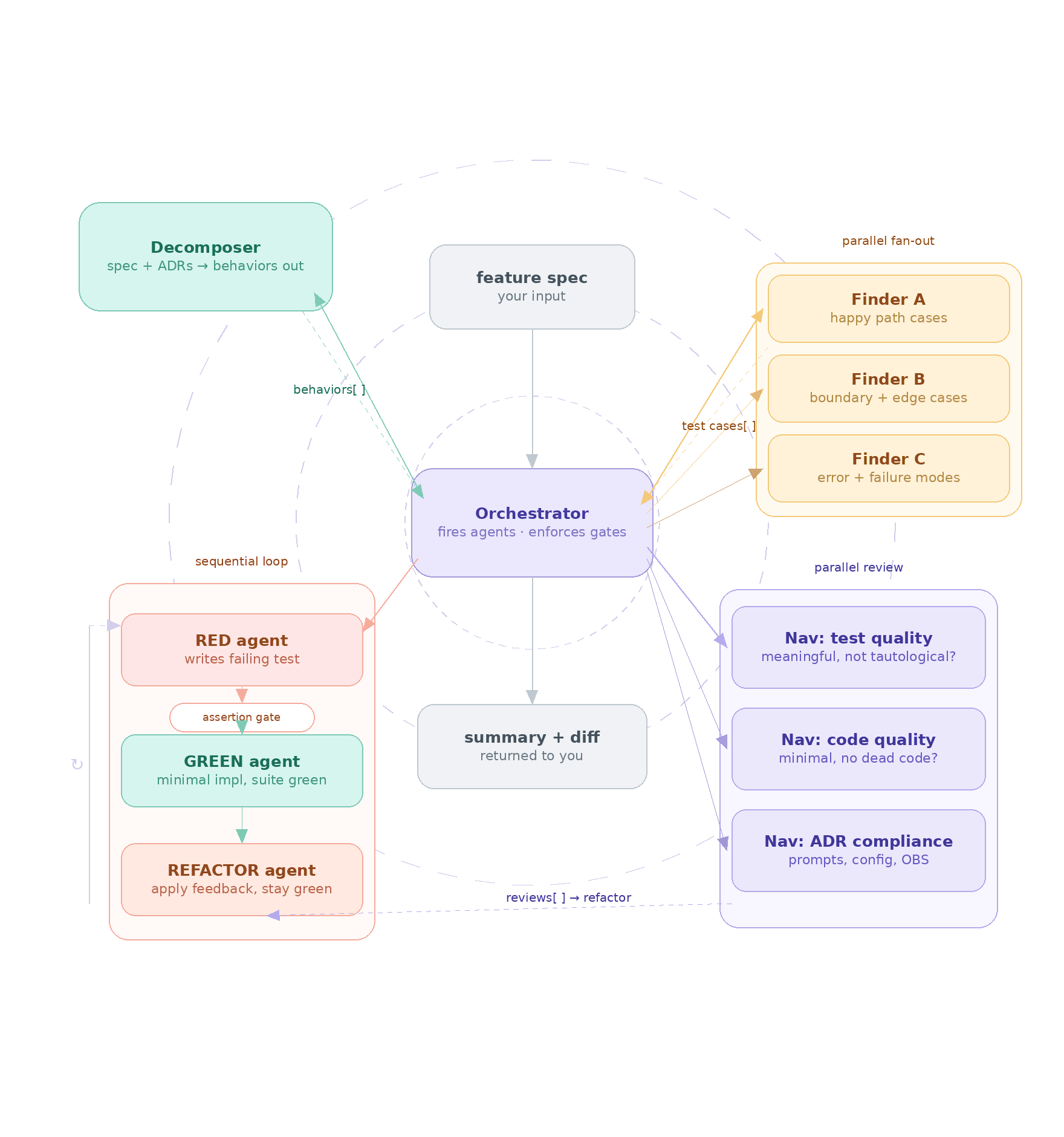
Recently I designed a workflow for Test-Driven Development pair programming. The goal was deceptively simple: give the system a feature spec, get back tested, reviewed, refactored code. Fully autonomous. No hand-holding.
The design ended up revealing something deep about where AI parallelism actually helps — and where it can't go.
- Decompose — one agent reads the spec alongside the project's architectural decision records, then outputs a dependency-ordered list of testable behaviors. ADR-first, by rule.
- Test Design — multiple agents fan out in parallel per behavior, exhaustively enumerating edge cases, error states, and happy paths. The parallelism here is real and additive: more lenses, richer coverage, before a single line is written.
- TDD Cycles — a strict sequential loop: RED → GREEN → REVIEW → REFACTOR. The reviewer step fans out again — three parallel "navigator" agents critique from distinct angles simultaneously. But the edits themselves are sequential, because the shared codebase demands it.
- Completeness — a critic cross-checks spec against test suite, feeds any gaps back through the cycle, and loops until nothing is missed.
What makes this design honest is where it refuses to parallelize. TDD's red→green→refactor is a tight loop over shared mutable state — a file tree that every agent reads and writes. Naive parallelism here corrupts itself. The workflow serializes what must be serialized and parallelizes only at the edges where it's genuinely safe.
Regular session vs. workflow: the real difference
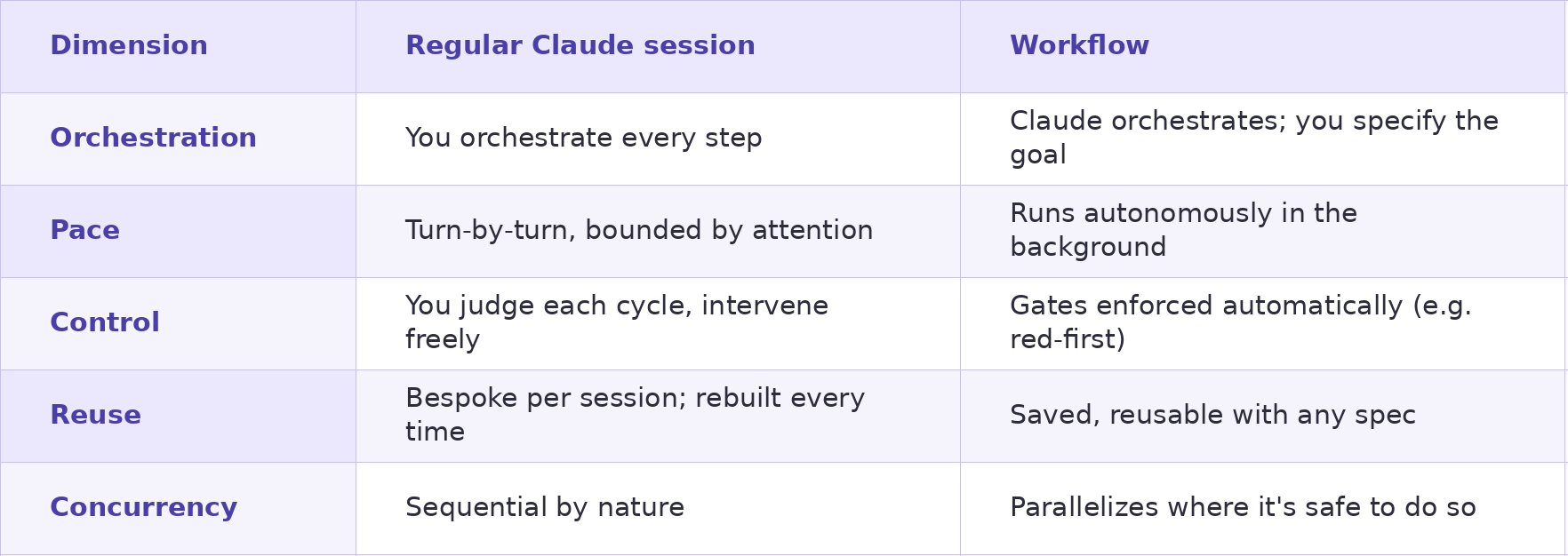
The trade-off is real: a workflow can't pause mid-run to let you weigh in on each cycle, the way a regular conversation naturally does. You trade responsiveness for scale. The workflow is ideal when the goal is well-defined; the session is ideal when the problem is still being discovered.
Why this trend is so exciting
What I find genuinely thrilling is that this isn't science fiction or a research prototype — it's available today in Claude Code. The pattern of decompose → fan-out → sequential-loop → completeness-check is one any engineer can reach for when a task is large enough to warrant it.
More broadly, it represents maturity in how we think about AI in the development loop. The first wave was autocomplete. The second was conversational assistance. This is the third: AI as a composable, orchestrable process — something you design, not just something you talk to.
The developers who thrive in this era won't be the ones who prompt most cleverly. They'll be the ones who design the best loops.
The spec is still yours to write. The commits are still yours to own. But the space between those two moments — the decomposition, the test design, the cycling, the review — that space is being handed back to you, free of toil, filled with rigor. That's the promise of workflows. And it's just getting started.